Activity Report: Themes & Issues >> Others
28 February-5 March, Hanoi, Vietnam
14-19 March, Jakarta, Indonesia
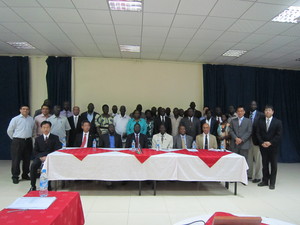
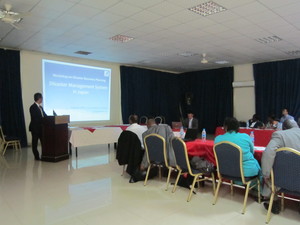
Asian Disaster Reduction Center (ADRC) conducted the program "Capacity Building of Utilization of Satellite Image for Disaster Management" in Hanoi, Vietnam from 28th Feb to 5th March, Jakarta and Indonesia from 14th to 19th March in cooperation with Asian Institute of Technology (AIT).
This program consists of one-day seminar and five- day training to promote the utilization of space based technology. It was held in collaboration with Remote Sensing Center, Ministry of Natural Resources and Environment (MONRE), Vietnam and Indonesian National Institute of Aeronautics and Space (LAPAN).
This is one of four capacity development programs in ASEAN countries that ADRC has been implementing since 2008,with other three including disaster education promotion, development of Web-based GLIDE-associated disaster database and capacity building of local government officials.
Satellite Images has been utilized to implement emergency activities in Vietnam and Indonesia. However, the experience of the engineers for utilization of the satellite data in these countries is insufficient. The capacity building of engineers in relevant field is in urgent need.
In Vietnam, the theme of case study is Flood. The satellite images before and after the flood were compared, which defined the flooding area.
In Indonesia, the theme of the case study is Tsunami. The struck area of the tsunami has been extracted from the simulation result of the tsunami.
ADRC will continue to cooperate with MONRE, LAPAN and other relevant agencies to further promote the utilization of satellite data in the field of disaster management. ADRC also plans to conduct the series of program in other ASEAN countries.
For more details of this project, please visit ADRC web site (http://www.adrc.asia/top_j.php).
12011/03/30 13:20
1-2 February 2011 (Bangkok, Thailand)
The Asian Disaster Reduction Center (ADRC) held the first regional workshop of the Japan-ASEAN Integration Fund Project on "Capacity Building in the Utilization of Satellite Images for Disaster Management" from 1 to 2 February 2011.
This workshop was organized in cooperation with the Asian Institute of Technology (AIT) and was held at the AIT Conference Center in Bangkok, Thailand.
This is one of the four capacity development programs in ASEAN countries that ADRC has been implementing since 2008, with other three including disaster education promotion, development of Web-based GLIDE-associated disaster database and capacity building of local government officials.
The purpose of the workshop was to allow relevant personnel to share information from the Report from the Seminar and Training for the Utilization of Satellite Images for Disaster Management, as well as other information regarding the use of satellite image for disaster management. The 27 participants, who represented the ASEAN countries, the ASEAN secretariat, the Japanese Embassy in Thailand, and UN agency, discussed efforts to promote the use of satellite images for disaster management activities.
The key points discussed were as follows:
1) Close ties between space organizations and disaster management organizations
2) Effective use of satellite information and the development of expertise and technologies
3) Use of ICTs other than satellite technologies to strengthen disaster management capacity
4) Mutual learning among countries though regional mechanisms
ADRC will continue to cooperate with relevant agencies to further promote the utilization of satellite data in the field of disaster management in ASEAN region.
For more details of this project and the result of this workshop, please visit ADRC web site (http://www.adrc.asia/top_j.php).
2011/02/21 13:20
17-23 October, Phnom Penh, Cambodia
Asian Disaster Reduction Center (ADRC) conducted the program "Capacity Building of Utilization of Satellite Image for Disaster Management" in Phnom Penh, Cambodia from 17th to 23rd October, in cooperation with Asian Institute of Technology (AIT).
This program consists of one-day seminar and five- day training, both to promote the utilization of space based technology. Especially the theme of this project in Cambodia was the drought. It was held in collaboration with Ministry of Land management, Urban Planning & Construction, Department of Geography in Cambodia.
This is one of the four capacity development programs in ASEAN countries that ADRC has been implementing since 2008, with other three including disaster education promotion, development of Web-based GLIDE-associated disaster database and capacity building of local government officials.
Satellite Images has been utilized to implement emergency activities in Cambodia. However, the experience of the engineers for utilization of the satellite data in these countries is insufficient. The capacity building of engineers in relevant fields is an urgent need.
ADRC will continue to cooperate with Department of Geography and other relevant agencies to further promote the utilization of satellite data in the field of disaster management. ADRC also plans to conduct this program in other ASEAN countries.
For more details of this project, please visit ADRC web site (http://www.adrc.asia/top_j.php).
2010/10/25 13:20
11-20 August, Bangkok, Thailand
27 August-3 September, Manila, Philippines
10-17 September, Nay Pyi Taw, Myanmar
Asian Disaster Reduction Center (ADRC) conducted the program "Capacity Building of Utilization of Satellite Image for Disaster Management" in Bangkok, Thailand from 11th to 20th Aug, Manila, Philippines from 27th Aug to 3rd Sep, and Nay Pyi Taw, Myanmar from 10th to 17th Sep in cooperation with Asian Institute of Technology (AIT).
This program consists of one-day seminar and five- day training, both to promote the utilization of space based technology. It was held in collaboration with Geo-informatics and Space Technology Development Agency (GISTDA), Thailand, Philippines Institute of Volcanology and Seismology (PHIVOLCS), and Ministry of Science and Technology (MOST), Government of Myanmar, respectively.
This is one of the four capacity development programs in ASEAN countries that ADRC has been implementing since 2008, with other three including disaster education promotion, development of Web-based GLIDE-associated disaster database and capacity building of local government officials.
Satellite Images has been utilized to implement emergency activities in Thailand, Philippines and Myanmar. However, the experience of the engineers for utilization of the satellite data in these countries is insufficient. The capacity building of engineers in relevant fields is an urgent need.
ADRC will continue to cooperate with GISTDA, PHIVOLCS, MOST and other relevant agencies to further promote the utilization of satellite data in the field of disaster management. ADRC also plans to conduct this program in other ASEAN countries.
For more details of this project, please visit ADRC web site (http://www.adrc.asia/top_j.php).
2010/10/06 13:20
14-23 July 2010, Vientiane, Lao PDR
Asian Disaster Reduction Center (ADRC) conducted the program "Capacity Building of Utilization of Satellite Image for Disaster Management" in Vientiane, Lao PDR from 14 to23 July 2010. This program consisted of one-day seminar and five- days training both to promote the utilization of space based technology, and it was conducted in collaboration with Asian Institute of Technology (AIT), and the Remote Sensing Center of Water Resources & Environment Institute, Water Resources and Environment Administration under Prime Minister Office (RSC/WREI/WREA), Government of Lao PDR.
This is one of the four capacity development programs in ASEAN countries that ADRC has been implementing since 2008, with other three including disaster education promotion, development of Web-based GLIDE-associated disaster database and capacity building of local government officials.
Satellite Images were utilized to estimate flood damages and to implement emergency activities when Vientiane was heavily inundated in August 2008. Through this experience, a shortage of engineers capable of applying space based technology to disaster management was recognized so that capacity building of engineers in relevant fields has become an urgent need.
ADRC will continue to cooperate with RSC/WREI/WREA and other relevant agencies to further promote the utilization of satellite data in the field of disaster management in Lao PDR. ADRC also plans to conduct this program in other ASEAN countries.
For more details of this project, please visit the following web site.
http://www.geoinfo.ait.ac.th/adrc/index.htm
2010/08/02 13:20
5-8 July 2010, Manila, Philippines
Sentinel ASIA Joint Project Meeting(JPTM) was held in Manila, the Philippines on 5-8 July 2010. It was organized jointly by Japan Aerospace Exploration Agency (JAXA), United Nations Economic and Social Commission for Asia and the Pacific (UNESCAP) and Department of Science Technology (DOST), Gov. of the Philippines. 71 people from 22 countries (36 organizations) and 5 international organizations participated in the meeting.
ADRC functions as a single window to receive emergency observation request for their screening and onward transmission to space agencies in the framework of Sentinel ASIA. At the meeting, ADRC reported the status of the emergency observations that were implemented in the last ○○ months, the results of survey on how provided satellite data was utilized in each country, and the current situation of the ADRC GLOF project. The themes of discussion in this meeting are as follows:
Progress of Sentinel Asia step2
Current situation of each JPT member
Activities of Forest fire Working Group
Activities of Flood Working Group
Activities of Glacier Lake Outburst Flood (GLOF) Working Group
Collaboration with Sentinel Asia and International Disaster Charter
ADRC will continue to promote the use of satellite data utilization for disaster reduction in Asia in cooperation with Sentinel Asia secretariat. For more details of this meeting, please refer to the Sentinel ASIA web site.
2010/08/02 13:20
15 April 2010 (Manila)
IRP facilitated coordination meetings with the Center for Disaster Preparedness (CDP) and the National Disaster Coordinating Council (NDCC) in the Philippines to document recovery lessons from Leyte Landslide of 2006. CDP is a resource center that works with NGOs, people's organizations, communities, and government agencies to enhance capacities in disaster preparedness, mitigation, emergency response, and recovery while NDCC is the national platform for disaster preparedness and emergency response. The meeting with CDP was held at CDP Conference Room, College of Social Work and Community Development (CSWCD) building, University of the Philippines, Diliman, Quezon City. In that meeting, IRP presented the rationale for developing the recovery status report and emphasized the importance of highlighting innovative practices and experience to generate knowledge build-up in recovery. The report will be used as part of the resources in developing the "Guidance Notes for Recovery", which is intended for national and local government to ensure "build back better". One important output of the meeting is the signing of contract between CDP and IRP/ADRC.
After meeting CDP, IRP paid courtesy visits to NDCC and Office of Civil Defense (OCD) to inform these offices of the project. IRP coordinates closely with these government offices to draw more inputs and make the recovery status report more useful to decision-makers and practitioners. The visits resulted in NDCC and OCD's expression of support to the project, especially in organizing a "national consultation" scheduled in November 2010, where concerned stakeholders in the Philippines will be gathered to validate and improve the recovery status report.
(2010/04/27 14:00)
20 March 2010 (Gandinagar, Gujarat, India)
IRP participated in the State-Level Consultation on Gujarat Recovery Status Report, 20 March 2010 held at Gujarat State Disaster Management Authority (GSDMA) Conference Room, Gandinagar City, India. The event, which was jointly organized by Global Forum for Disaster Reduction (GFDR) and Delhi University (DU) in close coordination with GSDMA, brought together over 20 representatives from various organizations in India, including national and local governments, local and international NGOs, development agencies, and academia.
During the consultation, IRP presented the rationale for developing a series of recovery status reports and emphasized the importance of highlighting innovative practices and experience in recovery to advance knowledge build-up. In particular, the Recovery Status Report on Gujarat Earthquake will help inform the development of Guidance Notes for Recovery to be used by national and local governments to ensure "build back better". The consultation resulted in (i) threshing out of issues and gaps in recovery process, (ii) sharing of experiences, good practices, and lessons, and (iii) deliberating the key messages drawn from Gujarat's unique recovery experience from the earthquake of 2001. The report will soon be uploaded in the IRP Website (www.recoveryplatform.org).
(2010/04/01 14:40)
15-19 March 2010 (New Delhi, India)
The second phase of national consultations on the development of "Guidance Notes for Recovery" to be used by national governments to ensure "build back better" was held in India Habitat Centre, 15-19 March 2010. The event was jointly organized by IRP and UNDP India to draw lessons, experiences, and stories of post-disaster recovery. Over fifty Indian experts in the fields of infrastructure, shelter, climate change adaptation, health, and psycho-social aspects participated in the consultation. Case studies, good practices, and stories on various aspects of recovery from the wealth of experience in India were drawn from the week-long consultations. The Guidance Notes offer "Menu of Options" for enhancing recovery operations, wherein policymakers and practitioners determine the contextual relevance of those options. Each sector-specific guidance note is evidenced-based highlighting relevant case studies. The Guidance Note is continually updating to generate new options. As follow through to the consultations, IRP will organize a writeshop in Kobe as well as facilitate peer reviews in April 2010.
(2010/03/31 14:40)
15-19 February 2010 (New Delhi, India)
IRP and UNDP India jointly organized the first phase of national consultations on the development of "Guidance Notes for Recovery" to be used by national governments to ensure "build back better". The Guidance Notes shall highlight lessons learned and good practices from global recovery operations, covering the sectors: Livelihood, Environment, Gender, Governance, Public Infrastructure, Shelter, Health, Psycho-social Aspects, and Climate Change Adaptation.
The national consu
ltations (Phase I) were held at UNDP Conference Room, New Delhi, 15-19 February 2010. Over 50 Indian experts in the fields of livelihood, gender, environment, and governance participated in the consultations. Case studies, good practices, and stories on various aspects of recovery from the wealth of experience in recovery from disasters were drawn from the consultations. The Guidance Notes will offer "Menu of Options" for enhancing recovery operations, wherein practitioner determines the contextual relevance of those options. It is evidenced-based that highlights case studies and it is continually updating to generate new options.
(2010/03/02 14:40)
21-23 December, 2009 (Bishkek, Kyrgyzstan)
The ADRC mission visited the Ministry of Emergencies to discuss the monitoring of nature disaster through space utilization and to further promote coordination in that field.
We also visited the Central Asian Institute of Applied Geosciences (CAIAG) to discuss the utilization of the Space Technology for monitoring of nature disasters.
(2009/12/24 17:30)
28-30 September 2009 (Colombo, Sri Lanka)
The ADRC mission visited the Ministry of Disaster Management and Human Rights and Disaster Management Center to discuss the monitoring of nature disaster through space utilization and to further promote cooperation in that field. We also visited the Department of Meteorology, Survey Department, Coast Conservation Department and National Building Research Organization, to discuss the role of the utilization of the Space Technology for monitoring of nature disasters.
(2009/10/06 17:30)
3-4 September 2009 (Jakarta, Indonesia)
The ADRC visited ASEAN Secretariat to discuss how to proceed on with the Feasibility Study on ASEAN Coordination Centre for Humanitarian Assistance on Disaster Management (AHA Centre) and how to prepare for a future project on disaster management communication network system in the ASEAN. The ADRC will be participating in the F/S on AHA Centre which aims to examine, inter alia, requirements and necessary resources for the AHA Centre to become fully operational.
The ADRC also visited the JST-JICA Project office to discuss how to implement the JST-JICA Project for Multi-disciplinary Hazard Reduction from Earthquakes and Volcanoes in Indonesia. Funded by JICA (Japan international Cooperation Agency) and JST (Japan Science and Technology Agency), the project aims to strengthen the platform of collaboration among researchers and officials concerned with disaster risk. The project team is composed of 6 groups, among which the ADRC has taken part in Group 6: Application of the research and establishment of collaboration mechanism between researchers and the government officials and Group 5: Education and outreach for disaster reduction.
(2009/09/10 13:10)
Meetings with focal point persons in Katmandu who are responsible for "Pull down Test of an existing house in Katmandu, Nepal" that has been planned as a part of Regional Technical Assistance of ERRP, and 4-day Training of Vulnerability Assessment of Buildings/Retrofitting and Recovery Preparedness for Municipal Engineers in Nepal" as a part of the country activity of ERRP Nepal were conducted in 15-25 July 2009. More details, please see the following mission report.
Mission Report
8 July 2009 (Singapore)
9 July 2009 (Jakarta, Indonesia)
ADRC has been implementing web-based GLIDE-associated disaster database development project in ASEAN countries since 2008 with the financial support by Japan ASEAN Integration Fund.
The objective of this project is to facilitate all 10 ASEAN countries to develop their own national disaster databases with GLIDE numbers incorporated. In 2008 ADRC invited 3 government officials in charge of disaster information from Lao PDR, Philippines and Thailand to Kobe and gave them two month training on GLIDE.
In 2009 the training program is scheduled from 5 October to 11 December with government officials from Indonesia, Singapore and Viet Nam. ADRC held kick-off meetings in 3 countries and discussed about this year's project.
3-12 June 2009 in Vienna, Austria
ADRC and United Nations Office of Outer space Affairs (UNOOSA) signed the cooperation agreement on establishment of ADRC UN-SPIDER Regional Support Office (RSO) on the occasion of the 52nd COPUOS, 4th Jun 2009.
At the Scientific and Technical Subcommittee, ADRC reported that ADRC and UNOOSA signed the cooperation agreement and made a presentation on ADRC activity.
Additionally at UN-SPIDER workshop, ADRC also reported that ADRC and UNOOSA signed the cooperation agreement and presented ADRC activity focused on the application of satellite imagery to disaster management.
ADRC has been implemented the project for the satellite Imagery Application to Disaster Reduction facilitated by Japan-ASEAN Integration Fund (JAIF).
Eight ASEAN member countries, namely, Indonesia, Philippines, Lao PDR, Myanmar, Thailand, Vietnam, Cambodia, Brunei Darussalam, has participated in this project.
ADRC in cooperation with the Asian Institute of Technology, AIT(http://www.ait.ac.th/) will be organizing a seminar and training in each country to enhance their capacity of satellite imagery application to disaster reduction.
To this end, the first round of kick-off meetings, were held in each country as shown below.
Based on the results of those kick-off meeting, ADRC and AIT, will work together to produce relevant materials to be used at planned seminars and trainings in each country http://www.geoinfo.ait.ac.th/adrc/index.htm
・National Institute of Aeronautics and Space, Indonesia, 22 March 2009
・Philippines Institute of Volcanic and Seismology, Philippines, 25 March 2009
・Remote Sensing Center, Lao PDR, 23 April 2009
・Ministry of Science and Technology, Myanmar, 12 May 2009
・Geo-informatics and Space Technology Development Agency, Thailand, 8 Jun 2009
・National remote Sensing Center, Vietnam, 10 July 2009
・Department of Geography, Cambodia, 27 July 2009
・Survey Department, Brunei Darussalam, 22 March 2010
(2010/03/30 13:20)
12-14 November 2008 (Bali, Indonesia)
The Asian Conference on Disaster Reduction 2008 (ACDR 2008) was held from 12-14 November 2008 in Bali, Republic of Indonesia. It was organized by the government of the Republic of Indonesia (State Ministry of Research and Technology (RISTEK)/National Disaster Management Agency (BNPB)), the government of Japan (Cabinet Office), the United Nations Secretariat of the International Strategy for Disaster Reduction (UN/ISDR), and the Asian Disaster Reduction Center (ADRC), in cooperation with the United Nations Office for the Coordination of Humanitarian Affairs (UN/OCHA) and the World Meteorological Organization (WMO). A total of 106 participants from 24 countries, mainly ADRC member countries, and from 14 organizations, including the UN, other international organizations, NGOs, and academic institutions, attended ACDR 2008.
During the sessions, reports were given on each country's progress with regard to the HFA, and participants discussed the issues that need to be examined and the direction that future efforts need to take. In addition, Mr. Shambhu Prasad Marasini from Nepal and Mr. Vu Thanh Liem from Vietnam reported on the ADRC's Visiting Researcher Program, as well as the activities they have been engaged in during their time in Japan on this program.
For furhter information, please visit the folloing site:
http://www.adrc.asia/acdr2008bali/index.html
(2008/11/30 09:50)
29-31 July 2008 (Kuala Lumpur, Malaysia)
The ADRC, with support from the Japan International Cooperation Agency (JICA), conducted the second year of the "NGO Training for Disaster Risk Reduction in Asia" Project from 29 to 31 July 2008 in Kuala Lumpur, Malaysia.
The second year program consisted of a three-day workshop during which first-year participants had a chance to share their experiences in their own countries and the knowledge they gained from the first year program with other Asian Disaster Reduction and Response Network (ADRRN) members. It was attended by six first-year participants, six new participants, and three resource persons from ADRRN members, an officer from the ADRRN Secretariat, and two researchers from the ADRC. During the workshop, participants discussed and shared their opinions on various topics including community-based disaster risk management, disaster risk reduction tools (town watching), climate change, and gender issues.
For more information, please visit the ADRC website (http://www.adrc.asia/highlights/NewsNo185).
(2009/03/16 16:50)