
TOP PAGE > Information on Disaster Risk Reduction of the Member Countries
Information on Disaster Risk Reduction of the Member Countries
 アルメニア
アルメニア
General Information
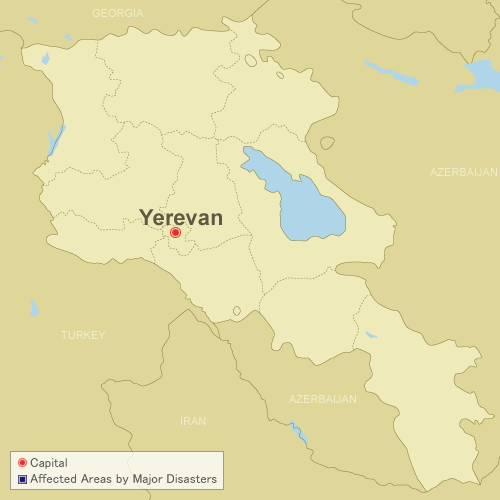 Formal Name: Republic of Armenia
The Republic of Armenia is located in the South Caucasus region, between the Black Sea and the Caspian Sea basins. Armenia shares its western border with Turkey, northern border with Georgia, eastern border with Azerbaijan, and southern border with Iran. The land area is about 29,700 square kilometers. Most of the territory is mountainous and covered with high plateaus, with an average elevation of approximately 1,800 meters above sea level. The climate is highland continental, characterized by hot summers and cold winters.
The capital of the Republic of Armenia is Yerevan. The population is approximately 3 million people. The vast majority of the population is Armenian, while ethnic minorities include Russians, Yezidis, Kurds, Assyrians, Greeks, Ukrainians, Jews, and representatives of other nationalities.
Overview of Disasters
Armenia is exposed to various types of natural hazards, excluding marine-related disasters due to its landlocked location. Among these hazards, earthquakes pose the most significant threat to the population and property. Approximately 94 percent of the overall natural disaster risk in Armenia is related to earthquakes, while other hazards, such as landslides, floods, and mudflows, account for the remaining 6 percent.
Recent Major Disasters
Spitak Earthquake (December 1988)
The Spitak earthquake occurred in December 1988 and was one of the most devastating disasters in the history of Armenia. The earthquake had a magnitude of approximately 6.9 and claimed the lives of about 25,000 people, while more than 500,000 people were left homeless.
Disaster Management System
Legal System
The National Assembly of the Republic of Armenia has adopted the following key laws related to disaster risk reduction and emergency management:
1. Law on the Protection of the Population in Emergency Situations (December 1998)
2. Law on Seismic Protection (June 2002)
3. Law on Fire Safety (February 1999)
4. Law on Safe Utilization of Atomic Energy for Peaceful Purposes (April 2001)
5. Law on Environmental Education and Public Awareness (November 2001)
6. Law on the Task Force and Status of a Rescuer (June 2004)
7. Principles of Environmental Legislation
1. Law on the Protection of the Population in Emergency Situations (December 1998)
2. Law on Seismic Protection (June 2002)
3. Law on Fire Safety (February 1999)
4. Law on Safe Utilization of Atomic Energy for Peaceful Purposes (April 2001)
5. Law on Environmental Education and Public Awareness (November 2001)
6. Law on the Task Force and Status of a Rescuer (June 2004)
7. Principles of Environmental Legislation
Organization
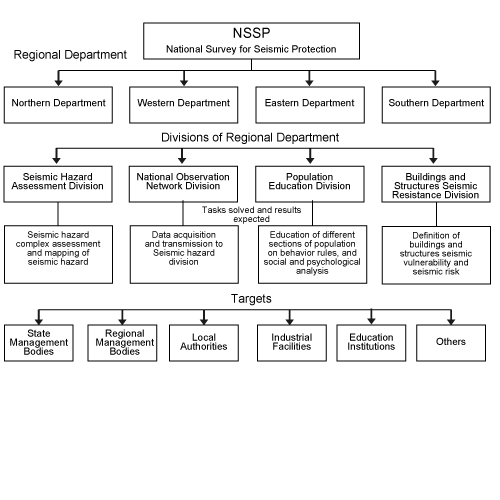 Following institutional reforms, disaster management at the national level is coordinated by the Ministry of Internal Affairs of the Republic of Armenia.
Earthquake disaster management is carried out through a dedicated system in which the Regional Survey for Seismic Protection (RSSP) plays a key scientific and operational role, implementing seismic monitoring, hazard assessment, and risk reduction measures.
Following institutional reforms, disaster management at the national level is coordinated by the Ministry of Internal Affairs of the Republic of Armenia.
Earthquake disaster management is carried out through a dedicated system in which the Regional Survey for Seismic Protection (RSSP) plays a key scientific and operational role, implementing seismic monitoring, hazard assessment, and risk reduction measures. Plan
The State Complex Program on Seismic Risk Reduction in the Territory of Armenia was formulated in 1999 and provides a long-term strategic framework for seismic risk reduction activities at the national level.
ADRC Counterpart
Country Report
Country Report 2025 (English Version, PDF file)Country Report 2022 (English Version, PDF file)
Country Report 2021 (English Version, PDF file)
Country Report 2017 (English Version, PDF file)
Country Report 2016 (English Version, PDF file)
Country Report 2015 (English Version, PDF file)
Country Report 2012 (English Version, PDF file)
Country Report 2010 (English Version, PDF file)
Country Report 2006 (Japanese Version, PDF file)
Country Report 2006 (English Version, PDF file)
Country Report 2003 (English Version, PDF file)
Country Report 2002 (English Version, PDF file)
Country Report 2001(English Version), PDF file