
TOP PAGE > Information on Disaster Risk Reduction of the Member Countries
Information on Disaster Risk Reduction of the Member Countries
 Philippines (the)
General Information
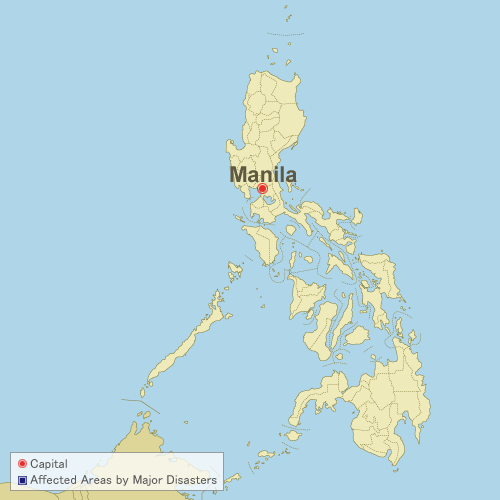 Formal Name: Republic of the Philippines
The Republic of the Philippines (RP) is located in Southeast Asia, bordered by the Pacific Ocean to the east, the West Philippine Sea to the west, and the Celebes Sea to the south. The Philippines constitutes an archipelago of 7,109 islands with a total land area of approximately 299,764 square kilometers. The Philippines has a tropical and maritime climate. It has two major seasons: the rainy season, from June to November; and the dry season, from December to May.
The capital is Manila. The population is 88.57 million as of August 2007. The Filipino is basically of Malay stock with a sprinkling of Chinese, American, Spanish and Arab blood, and other ethnic minorities.
Overview of Disasters
Located along the typhoon belt in the Pacific, the Philippines is visited by an average of 20 typhoons every year, five of which are destructive. Being situated in the “Pacific Ring of Fire” makes it vulnerable to frequent earthquakes and volcanic eruptions. Its geographical location and physical environment also contributes to its high-susceptibility to tsunami, sea level rise, storm surges, landslides, flood/flashflood/flooding, and drought.
Recent Major Disasters
Volcanic Eruption of Mt. Pinatubo (June 1991)
Volcanic eruption of the Mount Pinatubo in June 1991 was the largest volcanic explosion in the 20th century. It killed 640, affected 1,036,065. About 40,000 houses were destroyed, and more than 70,000 houses were damaged.
Super Typhoon Haiyan (November 2013)
Super Typhoon Haiyan, locally known as Typhoon Yolanda entered the Philippine Area of Responsibility (PAR) on 6 November 2013 and created new history for the Philippines. It affected a total of 3,424,593 Families or 16,078,181 Persons. Killing 6,318 persons, 28,689 were injured and 1,061 were still missing. It destroyed 1,140,332 houses and damaged a total of 19.6B pesos worth of Infrastructures and 20.3B pesos worth of Agriculture.
Luzon Earthquake (July 1990)
M7.6 earthquake occurred in the central Luzon killed 2,412, affected 1,597,553, and destroyed 100,000 houses with the estimated total loss of US$250million.
Disaster Management System
Legal System
On 27 May 2010, the Republic Act 10121 or the Philippine Disaster Risk Reduction and Management (PDRRM) Act was passed into law and paved the way for the need to “adopt a disaster risk reduction and management approach that is holistic, comprehensive, integrated, and proactive in lessening the socio-economic and environmental impacts of disasters including climate change, and promote the involvement and participation of all sectors and all stakeholders concerned, at all levels, especially the local community.”
The Act provides for the development of policies and plans and implementation of actions and measures pertaining to all aspects of disaster risk reduction and management, including good governance, risk assessment and early warning, knowledge building and awareness raising, reducing underlying risk factors, and preparedness for effective response and early recovery.
In compliance to RA 10121, the council adopted on June 2011, the National Disastesr Risk Reduction and Management (NDRRM) Framework, with the vision of attaining a “Safer, Adaptive and disaster-resilient Filipino Communities towards sustainable development”.
The NDRRM Framework indicates the paradigm shift towards a proactive and preventive approach to disaster management. The conceptual representation emphasizes that resources invested in disasters prevention, mitigation, preparedness and climate change adaptation will be more effective towards attaining the goal. The framework shows that mitigating the potential impacts of existing disaster and climate risks, preventing hazards and small emergencies from becoming disasters, and being prepared for disasters, will substantially reduce loss of life and damage to social, economic and environmental assets. It is also highlights the need for effective and coordinated humanitarian assistance and disaster response to save lives and protect the more vulnerable groups during and immediately after the disaster. Further, building back better after the disaster will lead to sustainable development after the recovery and reconstruction process.
The Act provides for the development of policies and plans and implementation of actions and measures pertaining to all aspects of disaster risk reduction and management, including good governance, risk assessment and early warning, knowledge building and awareness raising, reducing underlying risk factors, and preparedness for effective response and early recovery.
In compliance to RA 10121, the council adopted on June 2011, the National Disastesr Risk Reduction and Management (NDRRM) Framework, with the vision of attaining a “Safer, Adaptive and disaster-resilient Filipino Communities towards sustainable development”.
The NDRRM Framework indicates the paradigm shift towards a proactive and preventive approach to disaster management. The conceptual representation emphasizes that resources invested in disasters prevention, mitigation, preparedness and climate change adaptation will be more effective towards attaining the goal. The framework shows that mitigating the potential impacts of existing disaster and climate risks, preventing hazards and small emergencies from becoming disasters, and being prepared for disasters, will substantially reduce loss of life and damage to social, economic and environmental assets. It is also highlights the need for effective and coordinated humanitarian assistance and disaster response to save lives and protect the more vulnerable groups during and immediately after the disaster. Further, building back better after the disaster will lead to sustainable development after the recovery and reconstruction process.
Organization
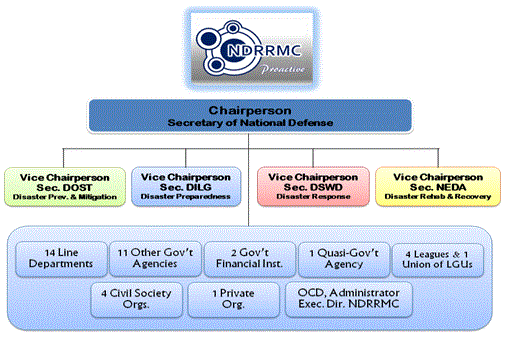 The National Disaster Risk Reduction and Management Council (NDRRMC), being empowered with policy-making, coordination, integration, supervision, monitoring and evaluation functions shall carry out 17 responsibilities as stipulated in the law. The NDRRMC Chairperson may call upon other instrumentalities or entities of the government and nongovernment and civic organizations for assistance in terms of the use of their facilities and resources for the protection and preservation of life and properties in the whole range of disaster risk reduction and management. This authority includes the power to call on the reserve force as defined in Republic Act No. 7077 to Assist in relief and rescue during disasters or calamities.
The Office of Civil Defense (OCD), as the implementing arm of the National Disaster Risk Reduction and Management Council, shall have the primary mission of administering comprehensive national civil defense and disaster risk reduction and management program by providing leadership in the continuous development of strategic and systematic approaches as well as measures to reduce the vulnerabilities and risks to hazards and manage the consequences of disasters.
Plan
The National Disaster Risk Reduction and Management Plan (NDRRMP) fulfills the requirement of RA No. 10121 of 2010, which provides the legal basis for policies, plans and programs to deal with disasters. The NDRRMP covers four thematic areas, namely, (1) Disaster Prevention and Mitigation; (2) Disaster Preparedness; (3) Disaster Response; and (4) Disaster Rehabilitation and Recovery, which correspond to the structure of the National Disaster Risk Reduction and Management Council (NDRRMC). By law, the Office of Civil Defense formulates and implements the NDRRMP and ensures that the physical framework, social, economic and environmental plans of communities, cities, municipalities and provinces are consistent with such plan.
ADRC Counterpart
Country Report
Country Report 2018 (English Version, PDF file)Country Report 2017 (English Version, PDF file)
Country Report 2016 (English Version, PDF file)
Country Report 2014 (English Version, PDF file)
Country Report 2012 (English Version, PDF file)
Country Report 2011 (English Version, PDF file)
Country Report 2009 (English Version, PDF file, 0.45MB)
Country Report 2006 (Japanese Version, PDF file)
Country Report 2006 (English Version, PDF file)
Country Report 1999 (English Version, PDF file)
Country Report 1999 (Japanese Version, PDF file)
Country Report 1998 (English Version, PDF file)