

TOP PAGE > Information on Disaster Risk Reduction of the Member Countries
Information on Disaster Risk Reduction of the Member Countries
 Bhutan
General Information
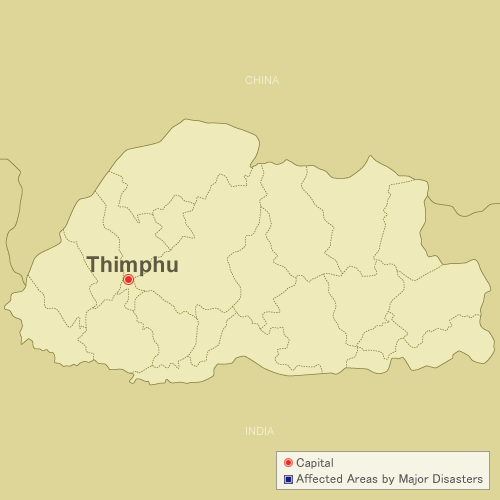 Formal Name: Kingdom of Bhutan
Bhutan is a landlocked country, sandwiched between the two Asian giants, with Tibetan plateau of China bordering the north and east, west and south by India. It has a total area of 38,394 square kilometers, located on the southern slopes of the Eastern Himalaya. It is characterized by a unique topography with land elevation ranging from 150m in the southern foothills gradually rising to about 7,000m towards the north. The country is endowed with numerous glaciers fed rivers that are being exploited to generate electricity. Bhutan has four seasons and the climatic condition varies with hot subtropical climate in the south to cool winters and hot summers in central valleys and severe winters to cool summers in the north. Bhutan has a population of 745,153 as of 2014 census record. The capital of Bhutan is Thimphu.
Overview of Disasters
Bhutan, like the rest of the world, has not been spared by the fury of natural hazards and is susceptible to many kind of it. Geo-physically, Bhutan is located in the young Himalayan Mountains and considered to be one of most seismically active zones in the world. As per the Indian Seismic Code, Bhutan lies in the seismic zone IV and V, which is most active zones. Considering the location and as proven by the past earthquakes, earthquake is the one of the most imminent hazards in Bhutan. As a result of global warming, Glacier Lake Outburst Flood (GLOF) poses another risk to the people of Bhutan. Due to the climatic change, the seasonal strong wind becoming one of the hazards in Bhutan, it causes lots of damages to the rural homes in Bhutan. The 2011 and 2013 Windstorm caused huge damage to rural homes in Bhutan. Other hazards such as landslides, flash flood and forest/structural fires also sweep across the country causing significant losses to the properties and lives of people.
Recent Major Disasters
Earthquake (September 2011)
Bhutan was hit by an earthquake on the 18 September 2011, measuring 6.9 magnitude on the Richter scale causing a loss of one life due to the landslide triggered by the earthquake, 14 injuries and structural damages worth of Nu 1,197.63 million (approx. 24.5 million USD).
Flash Flood (June 2013)
A flash flood caused by incessant heavy rain affected 6 Blocks of Punakha District. Several acres of land were filled with debris and sand; some of them were washed away. One Culvert bridge was washed away.
Windstorm (December 2013)
13 Districts, 53 Blocks and 1 Town were affected by the windstorm of 15th December, 2013. 979 private houses, 12 schools, 50 Lhakhangs/Nunneries/Monasteries, 3 Geog (Block) Offices & 8 Basic Health Unit/Outreach Clinic were damaged.
Disaster Management System
Legal System
No policies or guidelines related to disaster risk management were in place prior to 2006 till the Royal Government of Bhutan adopted the National Disaster Risk Management Framework (NDRMF) in 2006. However, with increasing occurrence of disasters across the country, a strong need arose to ensure systematic DRM approach and provide responses as required. This need led to the enactment of the Disaster Management Act of Bhutan 2013 on the 18 March 2013.
Organization
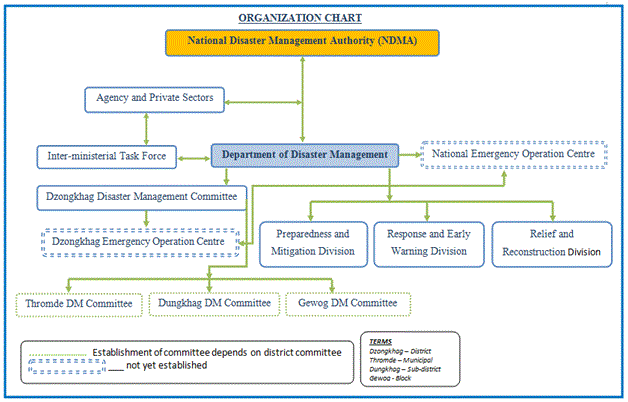 The official organization for disaster management is Department of Disaster Management (DDM), Ministry of Home and Cultural Affairs. The DDM is Secretariat of National Disaster Management Authority (NDMA). The NDMA is the highest decision making body on disaster management in Bhutan as per Section 8 of the Disaster Management Act, 2013
 Plan
- Disaster Management Planning Guideline
As per the Disaster Management Act of Bhutan 2013, Disaster Management Planning Guideline has been drafted to assist and guide the Districts and other relevant agencies/sectors.
-Disaster Management Contingency Planning Guideline
-School Disaster Management Planning Guidelines
In collaboration with Department of School Education, the Planning guideline for the formulation of the School DM Plan has been developed and distributed.
- Five year plans of Bhutan
Mainstreaming disaster resilience and management is highlighted as one of the 16 National Key Result Area (NKRA) of the Royal Government of Bhutan for the period of 11th Five-Year Plan (ie.2013-2018).
- National Recovery and Reconstruction Plan for 2009 Earthquake
- Environmental Management Framework for Bhutan : Improving Resilience to Seismic Risk
- Guidelines on Proper Construction Practices for Non-Engineered Building (Stone Masonry)
- National Action Plan for School Earthquake Safety
- National Action Plan for Earthquake Safety of Health Facilities
As per the Disaster Management Act of Bhutan 2013, Disaster Management Planning Guideline has been drafted to assist and guide the Districts and other relevant agencies/sectors.
-Disaster Management Contingency Planning Guideline
-School Disaster Management Planning Guidelines
In collaboration with Department of School Education, the Planning guideline for the formulation of the School DM Plan has been developed and distributed.
- Five year plans of Bhutan
Mainstreaming disaster resilience and management is highlighted as one of the 16 National Key Result Area (NKRA) of the Royal Government of Bhutan for the period of 11th Five-Year Plan (ie.2013-2018).
- National Recovery and Reconstruction Plan for 2009 Earthquake
- Environmental Management Framework for Bhutan : Improving Resilience to Seismic Risk
- Guidelines on Proper Construction Practices for Non-Engineered Building (Stone Masonry)
- National Action Plan for School Earthquake Safety
- National Action Plan for Earthquake Safety of Health Facilities
ADRC Counterpart
Country Report
Country Report 2019 (English Version, PDF file)Country Report 2017 (English Version, PDF file)
Country Report 2014 (English Version, PDF file)
Country Report 2013(English Version, PDF file)
Country Report 2008(English Version, PDF file)