Russia
Country Report
1999
Contents
U.The Ministry, called
to save
W.Crisis Management
Centre (CMC)
Z.Central Airmobile
Rescue Detachment (TSENTROSPAS)
].Russian international
training center for rescuers
XI.Technical safety and new technologies
XII. Aviation on Emercom of Russia's service
XIII. Scientific researches in the field of civil protection
XY. EMERCOAM of Russia’s international
activities
PROPOSALS on cooperation in the field of earthquake monitoring and
forecast
PROJECT No 1 Seismic risk
monitoring and forecast system
PROJECT No 5 Training course “Land
Surface Remote Sensing by Space Monitoring Systems”
Proposals of works on assessment of buildings in the disaster area.

THE TASKS OF THE SYSTEM:
●Execution of state expertise, supervising and control in the field of population and regions protection against emergency situations;
●Preparation and implementation of the legal and economic regulations connected with population and regions protection against emergency situations;
●Implementation of the purpose-oriented and scientific-technical programmes on emergency situations prevention;
●Stand-by provision of the forces and assets allocated for emergency prevention and response;
●Information collection and processing. exchange and forwarding on the issue of population and regions protection against emergency situations
●Awareness of the population for the actions in case of emergency situations occurrence;
●Forecasting and evaluation of possible social and economic consequences and effects resulted out of emergency situations;
●Accumulation of financial and material resources reserves for emergency response;
●Emergency situations mitigation and response;
●Execution of the social protection measures for the population suffered as a result of emergency situation and, inter alia, humanitarian operations implementation
●International cooperation in the field of the population and regions protection against emergency situations.
---------------------------------------------------------------------------------------------------------------------------
- Your Excellency,
Your Ministry’s record shows quite a lot of commendable deeds.
How can you possibly
spell out the EMERCOM of Russia’s credo?
- We are following one
simple guidance: the human’s life has the top priority, regardless of
nationality, religion, beliefs and skin colour. Everyone has a legal right to
be rescued, therefore ・to get our assistance, and we are ready to provide it.
A fragment of an Interview, granted by Mr.S.Shoigu, Minister of Russian Federation for Civil Defence, Emergencies and Elimination of Consequences of Natural Disasters (EMERCOM of Russia), to the Delovoy Mir”(“Business World”) newspaper.
---------------------------------------------------------------------------------------------------------------------------
Ministry of Russian Federation for Civil Defence, Emergencies and Elimination of Consequences of Natural Disasters(EMERCOM of Russia) was established on January 10, 1994, according to the President of Russia’s Ordnance, although EMERCOM of Russia used to celebrate its birthday on December 27, as it was the exact day in the year of 1990, when the Russian Corps of Rescuers had been created, with the purpose to provide swift and effective response in case of emergency situations occurrence.
In the period of six years of its existence, the Ministry completed a number of the operations, resulted with the human lives, huge natural and material resources spared. EMERCOM of Russia represents a federal body of executive power and, as such, is tasked with the following:
●Governmental policy proposals drafting in the field of civil protection, emergency situations prevention and response, including nuclear disasters and accidents;
●provision of functioning and further development for the Unified Emergency Situations Prevention and Responce State System;
●Control over Russian Federation Civil Protection as well as Search and Rescue Service;
●implementation of activities in the field of emergency situations prevention and response;
●control over actions connected with wide-scale disasters, accidents and another emergency situations response;
●supervision over the legal financial spending of the resources, allocated by the Government for emergency situations response activities;
●organisation of training and preparedness of the population for the proper reaction and actions in case of emergency situations occurrence.
The Government’s
strategy to decrease risks and to mitigate the
consequences of the
emergency situations designed for the period up
to the year of 2012
exemplifies one of the principal directions in the
Russian Government’s
policy, which is supposed to be implemented by
EMERCOM of Russia.
First Vice-Minister Yu.Vorobiev

EMERCOM of Russia’s CMC represents a main body for the day-to-day
management of a Unified Emergency Prevention and Response State System (UEPRSS)
and, as such, is tasked with the following:
1. Provision
of firm and continuos management of the forces and assets allocated for
emergency prevention and response.
2. Provision
of necessary information for the system as a whole and for EMERCOM of Russia.
3. Coordination
of all UEPRSS segments activities. CMC principal services are on stand-by duty
round the clock. Apart of communications and hardware experts, duty service
comprises chief duty officer and duty shift officers. Chief duty officer is to
organize an immediate initial response on an emergency situation until eventual
deployment of the emergency response temporary HQs.
Duty shift officers are responsible for the information’s
collection, evaluation and processing automatically, as well as for supporting
the emergency response temporary Hqs and meeting its informational
requirements. This shift is capable of gathering information on several
emergency situations occurred on federal or regional level, as well as of
monitoring situation on the places of earlier disasters emergency response.
The duty shift processes and enters into unified information net of
the Ministry the information about all emergency situations originated by all
Russian Federation entities and by the relevant duty services of the federal
ministries and agencies. This particular net is receiving an information out of
the regions and is storing operational and reference information on the
emergency situations which is used by the forecast services. Processed
forecasts then are sent back to Crisis Management Centre to represent a base
for any future decisions taken by the leadership of the Ministry.
In general, the unified information space has been created which
allows close interaction with the President’s Office, Russian Government and
another sister-ministries and agencies.
Civil
protection troops numbered now 23,000 of personnel, represent a backbone of the
Russian Ministry of Emergency Situations. Their tasks include the following:
・reconnaissance of the situation in the places of emergency
situations occurrence;
・localisation of emergency situations; implementation of rescue and
another recovery and mitigation works;
・provision of relief, assistance and evacuation of the affected
persons;
・population life support.
These
troops are composed of the rescue brigades, mechanized civil protection
regiments and battalions, special protection companies and detached helicopters
squadrons. They are armed with the specialised equipment, such as engineering,
medical, radiation, chemical and biological protection. Nowadays civil
protection troops are equipped with the modem devices and emergency rescue
tools to implement their missions in the emergency situations zones, as well as
with the high-negotiating capabilities specialised vehicles.
In
the peace time the civil protection troops are functioning within the framework
of the Unified Emergency Situations Prevention and Responce State System. As
for the war time, they are under control of the Civil Protection system. In any
occasion ,their primary task is to protect the country’s population and its
territory while emergency situations.
The
search and rescue services, built upon the base of different tourist' and
Mountaineers' rescue services represent a first-line asset in the framework of
the Ministry's emergency response services. Their main mission is to provide immediate and effective
assistance to the people endangered with the emergency situations. In the
course of the rescue works, the search and rescue services coordinate their
actions with the regional headquarters for civil protection and emergency situations,
along with the Interior Ministry and Health Ministry units and detachments.
They are greatly involved as well into the education programmes for the
population concerning the rules of behaviour in the open nature, first-aid
provision in case of the accidents.
Nowadays
Russia counts 58 search and rescue services, deployed in the most vulnerable
natural or human created disasters regions.

--"The
people of this courageous profession are quite frequently in the dead centre of
the most dangerous trials as earthquakes, floods, fires and alike. They do
deserve our common gratitude and appreciation for their selflessness,
intrepidity and high motivation."
("Rossiyskaya
gazeta" newspaper)--
EMERCOM of Russia Rescue service’s pride and elite is represented by
the Central Airmobile Rescue Detachment, created back in 1992. It lists 310 of
personnel, who are the top professionals and consider their lives unworthy
without saving peoples.
The principal services of “TSENTROSPAS” are the following: rescue,
rescue works logistical support, air support, transport, communications and
information, expeditional,
airmobile hospital.
In conjunction with the different types of rescue operations
implementation, the detachment is also capable of unique airdropping of the
assorted loads, equipment and the modules of the airmobile hospital to the
place of emergency situations occurrence.
The detachment is supplied with the highly diversified specialised
equipment, life-supporting devices, means of affected persons delivery, search
and rescue, all types of communications, including satellite ones, helicopters
of Mi-8 and MBO-105 types, high-negotiating features vehicles.
TSENTROSPAS implements immediate search and rescue works within
Russian Federation and abroad, delivers humanitarian supplies to the emergency
situations zones, evacuates population out of the disaster and social unrest
areas. The rescuers of the detachment, where eight among them are
internationally certified, took part into 130 actions and operations in Russia
and in the foreign countries.
Canine
service is supposed to be the freshest one in the Ministry, although it is not
possible today to imagine the rescue works without the specially trained dogs.
This service is responsible for the training of the rescue dogs conductors, as
well as the drilling and training of the service dogs which are widely used to
search for the victims in case of earthquakes, explosions, buildings
destruction and avalanches. There is a sufficient number of working dogs of the
different breed, like German shepherds, Russian spaniels, Newfoundlanders, Labradores,
American Staffordshire terriers.
This
service may recall quite a number of operations to save the human lives and to
search for the victims, like earthquake in Neftegorsk, Kaspiysk, aircrash near
Abakan, search for the survivors while avalanches in the Central Caucasus mountains.
Good
relations are established with the sister-services of the foreign countries,
which have quite an experience in the service dogs' employment for the rescue
operations, to name but a few: Switzerland, Austria, France and the others.
The
Civil Protection Academy, created in 1992, is the leading
training-methodological and scientific center in the field of civil protection.
The Academy is training the professionals on the state and municipal levels of
management, civil protection engineers for emergency situations, engineers with
the mathematical education.
Nowadays
there are 2 Russian Academy of Science members, 2 members-correspondents, 10
doctors and 44 candidates among the teaching personnel of the Academy.
Concentrating
mostly on the scientific researches, Academy’s teachers are studying,
evaluating and processing national and international experience in the field of
emergency situations prevention and response, elimination of consequences of
natural disasters and accidents, population’s protection and life support,
safety of the industrial facilities, economy’s mobilisation preparedness. The
Academy is also responsible for the management of the regional training and
methodology centers for civil protection and emergency situations.
Academy’s
graduates are employed by the different ministries, federal and municipal
executive bodies, they are teaching in the higher education facilities and
serving in the Civil Protection Forces.
Since
1995, the Academy is training the foreign experts in civil protection in order
to increase their professional skills in accordance with the programmes,
adopted by the International Civil Defence Organization and UN Department of
Humanitarian Affairs.
This Center was inaugurated in 1996 as an international facility of humanitarian nature. Representing a structural branch of the Civil Protection Academy, the Center is dealing with the training and professional skills improvement of the rescuers and emergency rescue services’ experts.
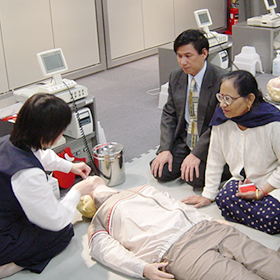
The Center is situated in the vicinity of Moscow, in the town of Noginsk. It is equipped with the modern training facilities, as well as a unique training range which enables to simulate the different types of emergency situations (devastation, debris of high story buildings, communal and power supply network wreckage, vehicles accidents, fires etc.) in order to implement emergency rescue works drills.
The Center’s instructors are the high class professionals, profoundly experienced in the practical, scientific and training activities. The training methodology was prepared by EMERCOM of Russia’s experts on the basis of the international law. Approximately 70 % of the training time is allocated for the practical drills, and another 30 % - for the theoretical classes, including fire fighting, medical and psychological education.
The principal modus operandi of the Center is represented in its openness which
makes it easily accessible and available for any countries and organizations.
Technical safety for the Ministry’s services is ensured by a Special Centre of the Ministry, created in 1995, which was tasked with unified technical policy provision primarily, in the field of information protection soft-ware, by means of computer virus-killing programmes creation and implementation. Secondly, the Centre was licensed with certification tests rights, and a special workshop was set up to ensure the highest degree of technical safety for the search, rescue and another operations equipment. This work shop is supposed to test and to issue certificates on the equipment and tools which influence greatly by their quality the effectiveness of the Ministry’s rescue services activities.
Besides, the Centre implements unified technical approach to the navigation equipment for the rescue operations. A programme called Leader Info-Navigation System U is worked out which includes contemporary Russian and foreign technologies. Humanitarian supplies convoys safety is ensured by the specially equipped escort vehicles. Such vehicles, due to their satellite or the other means of communications, provided permanent duplex radioexchange with the humanitarian convoys while relief operations in Chechnya, Georgia, former Yugoslavia, Rwanda.
Robotic equipment is coming to assist the Ministry’s rescuers as well. One of the best models in the range of the unmanned small aircrafts, for example, which is used for the search operations, is a guided unmanned vehicle called Pronya with the digital photo camera on board. Economical and user-friendly, it can fly over the territory on the distances up to 15 clicks. With its high precision snapshots, Pronya could be of great assistance while affected persons searching as a result of floods, avalanches and another emergency situations.
EMERCOM of Russia’s experience shows
that nowadays it 15 not possible to implement practically any serious task
connected with emergency situations response without aviation component.
Aviation’s ability to deliver rescuers, equipment, medicine and different loads
to the places of emergency situations occurrences almost in no time defines its
role as a pillar, which the mobility and effectiveness of the Russian emergency
service is rested upon.
To
mention an example of the new aviation technologies creation and functioning
there is the utilisation of the heavy transport aircrafts of “IL76”type for the
purpose of massive forest fires fighting. The State Aviation Enterprise of the
Ministry is equipped with five of them, fitted with the special vapor
dispensers (tanks) of 42 MT volume of water or fire extinguishing liquid. In
the year of 1996, these aircrafts were fighting forest fires in the region of
Khabarovsk, as well as participated in the firefighting on the oil depot in the
vicinity of Volgograd.
The
aviation technologies further development is connected primarily with new
Russian aircrafts acquisition. Soon it is planned to equip the Ministry with a
multipurpose aircraft of “BE-200”type, capable of taking 12 MT of water on
board while gliding on the water surface which will increase greatly the
effectiveness of the firefighting. New emergency rescue helicopter of “Ka-226A”type
is already cooked up, fitted with two “Alisson” engines.
This helicopter is expected to be better than the foreign ones of the
same type and to solve the problem of the rescue works implementation in the
most complicated conditions like inside such megalopolises as Moscow and
St-Petersburg.
The
All-Russian Research and Scientific Institute for Civil Protection and
Emergency Situations Problems is playing a leading role in scientific support
and provision for EMERCOM of Russia’s activities, It was established in 1976
and since then has completed more than 1000 scientific research and
construction testing works which were widely recognized in the scientific
community. This is the only
organization in Russia and CIS countries which is able to provide complete
solution of the principal scientific problems such as:
・population and environment protection in case of the different types
of disasters and accidents;
・creation, functioning and development of the systems to control,
prevent and respond to the emergency situations;
・new technologies’ development, including the production of the
rescue and search equipment.
The institute is
keeping a renewed bank of information on the natural and human-created
emergency situations on the Russian territory. Apart of this, it is dealing
with the evaluation of the potential risks in the different regions (to ensure
security of the investments there), and with the wide-scale researches in the
field of nuclear materials stability and reactions in different environment.
On
the base of this institute a new facility -Emergency Situations Monitoring and
Forecasting Agency is now being created.
The
institute cooperates in its researches with more than 100 scientific and
construction testing Russian organizations. It implements now researches
connected with the space monitoring of accidents and disasters in accordance
with one of the programmes developed by the EUR-OPA Major Hazards Agreement
One
of the principal directions of EMERCOM of Russia’s activities is the
familiarisation of the population with the rules of behaviour in extreme
situations. This task lays within the mainstream of the state measures system
to protect the population and the territories against emergency situations.
Several
years ago, a new training programme was introduced for the high-school
and
professional education. It was called “Life-support safety basics and aimed at
the development of “human being self-protection skills. Logically, this type of
training proceeds with three following stages:
・definition of the threatening situation; measures to avoid it;
・sequence of actions in case of personal involvement occurrence.
The
similar programme has been included into the educational process of the higher
education facilities, where the plan of training might be diversified according
to the facility’s speciality. Great attention in this programme is concentrated
on the prevention of emergency situations, considering the degree of the
professional necessity of it for the different groups of the students. For
example, the would-be engineers should be aware of the kind of the situations
which might happen in the chemically endangered facility and what should be
done in order to prevent such occurrence.
EMERCOM
of Russia is working in close contact with mass-media agencies. In accordance
with the Ministry's request a special radio programme called “Survival school
and a TV-programme named “TV-guard” have been produced and aired regularly.
These programmes explain the correct behaviour of a person in the extreme
situation. Besides, the Ministry supports printed publications aimed at
increasing population’s awareness of the proper actions in emergency
situations. Its own illustrated magazine, having wide experience and proved
traditions, is serving the same purpose.
As
experience shows, it is possible to increase the effectiveness of the emergency
rescue works, to diminish the period of emergency response and, at last, to
minimize human and material losses twice or even thrice capitalising on the
improvement of the technical assets for the rescue units.
Thus,
EMERCOM of Russia holds annually an international exhibition called Rescue
means which becomes a presentation
of the top-on-the-line samples for rescue equipment and tools produced in
Russia and abroad. Exhibition booths vary a lot by their issues covered, such
as:
・methods of natural and human-created disasters prevention and
response;
・rescue works implementation technology;
・emergency rescue and fire fighting equipment and tools;
・personal and group protection gear;
・chemical, radiation and ecological monitoring and control means;
・special wear and equipment for the rescuers;
・prefabricated living facilities and tents;
・water purification systems;
・emergency ambulance and first-aid etc.
On
such exhibitions expertise and evaluation commissions composed of EMERCOM of
Russia’s experts are working to evaluate and to choose the best samples of
production. The popularity and
worthiness of Rescue means exhibitions among the experts and producers is
proved and confirmed by the fact that the first one, called in the year of
1994, was at tended by 95 participants, whereas the fourth one, which is
planned to be held in Moscow on summer-97, is expected to gather more than 200
producers out of 20 countries.
A
number of emergency situations and their consequences might influence the
neighbouring countries, as well as the humanitarian disasters might endanger
the whole regions. This situation requires finely tuned working cooperation on
the contemporary international legal basis. The Ministry develops multifaceted
cooperation with the relevant emergency services and humanitarian structures of
United Nations, European Union, NATO and the most experienced and developed
countries in the field of common professional interests. EMERCOM of Russia is
closely working with the Russian Foreign Ministry in this direction. Several
bilateral and multilateral interstate agreements have been prepared and are now
in force with many countries - members of the Commonwealth of Independent
States and another foreign states (Germany, Italy, France, Switzeriand, USA,
Bulgaria etc.). New agreements on cooperation with such countries like Ukraine,
Spain, Japan, China, Norway and Baltic states are in the process of
preparation.
In
1996, a Memorandum was signed in Moscow within the framework of Gor-Chemomyrdin
Commission between the governments of the Russian Federation and the United
States of America on cooperation in the field of human-created emergency
situations prevention and disaster mitigation and response, which represented a
new step on the road of cooperation between two countries.
Same
year, Mr.S.Shoigu, the Ministerof Russian Federation for Civil Defence,
Emergencies and Elimination of Consequences of Natural Disasters (EMERCOM of
Russia) and Mr.X.Solana, NATO’s Secretary-General, have signed a Memorandum of
Understanding in the field of civil emergency planning.
EMERCOM
of Russia cooperates quite closely with the relevant international
organizations, which coordinate different nations efforts in the international
rescue and humanitarian activities, as well as training of national personnel
for these purposes. They list UN Depertment of Humanitarian Affairs (UN DHA),
UN High Commissioner for Refugees (UNHCR), International Civil Defence
Organization (ICDO). MERCOM of Russia perticipates within the described range
of international cooperation in the implementation of the World-wide long-term
programmes and projects, such as Military and Civil Defence Assets for
Emergency Response, World Food Programme” “Chemobyl” “World Aid, and the
regional ones, for example, in Rwanda and former Yugoslavia, to name but a few.
In
1995, the Russian National Corps for Emergency Humanitarian Response (RNCEHR)
was established by the Russian Government Resolution. This Corps is able to
work independently in any region of the world complying fully with UN
standards. EMERCOM Agency has became the managing and coordinating focal point
of the Corps. Its main tasks include the following:
-
the establishment and development of the working relations with UN and another
international humanitarian organizations; provision of the contemporary
advanced machinery and equipment for the Corps;
-
coordination of the airmobile task forces actions in case of emergency
situations occurrences abroad;
-
presentation and development of Russian initiatives on the humanitarian actions
implementation;
- attraction of the investments,
necessary to support Russian integration to the world economy’s system within
EMERCOM of Russia’s responsibilities.
According
to the contract, signed with UNHCR, EMERCOM of Russia’s humanitarian trucking
convoys have been delivering humanitarian relief to the encircled
anclaves in
Bosnia and Herzegovina and to the refugees and internally displaced persons in
the former Yugoslavia for three years. The similar convoys worked on the
mountain roads of Georgia, frequently delivering fuel and lubricants for the
Russian Orthodox religious community of Dukhobores (“Spirit Fighters").
Swift and efficient actions of EMERCOM of Russia's aviation and trucking
convoys in Tanzania and Zaire spared thousands of human lives and laid the
basis for the restoration of cooperation with the African countries.
In
the year of 1997-1998, EMERCOM of Russia, together with the foreign scientists,
is planning to continue the further realisation of the new airmobile
technologies and another advanced researches in the field of rescue machinery
and tools, seismology and space monitoring.
Project goal is to develop a system of seismic risk short-term/medium-term monitoring and forecast adapted to the local conditions.
The forecast efficiency may be 0,7-0,8; forestalling time varies from one week to 30 minutes.
Project goal is to increase the adequacy of emergency response to devastating earthquakes and reduce social and economic losses.
Project goal is to develop a mobile system of site construction control for timely finding of destruction prone facilities, development of dynamic digital maps on engineering risk of settlement/city/district destruction and potential effects of natural/man-made risks.
Construction site inspection time varies from one to three hours.
Project goal is to specify dangerous sectors of pipe-lines and to reduce social losses and property damage at oil facilities.
The project may be implemented both for pipe-lines being in operations or under development.
Project goal is to teach the trainees to make qualified decisions on the fact of emergency situation, its consequences and required relief operations. The course duration is one month.
Training courses correspond unified international standards and are developed on the basis of training programs FORM-OSE and STRIM
Training course duration -two weeks.
Training group comprises 5-10 persons.
The assessments works are planned to performed in two stages:
- eliminary and
- major.
The preliminary stage includes (without using of equipment of the mobile diagnostic complex for seismitity assessment):
1. Travel of EMERCOM of Russia experts for reconnaissance into the disaster zone, collection of the appropriate information for subsequent work to assess the seismitity of buildings and their design specialty, as well as the seismogeological conditions of disaster zone.
2. Design of the program on assessment of buildings and determination of the degree of their damage on the MSK-86 international scale, as well as working out of proposal on the further utilization of buildings.
Duration: two weeks
Number of experts: 3 persons
Cost of work: 18000 USD (the prepayment: 8000 USD).
The major stage includes (using of equipment of the mobile diagnostic complex).
1. Assessment of the real seismitity of buildings and the degree of their damage using equipment of the mobile diagnostic complex.
2. Presentation of a monthly report on the results of assessment of buildings including the data on their real seismitity, the degree of their damage, as well as proposals of their further utilization.
Duration: one year
Number of experts: 12 persons
The amount of work is the following: assessment of up to 3000 buildings (to be specified according to the results of preliminary stage).
The cost of work at this stage is calculated depending on the number of assessed buildings and the number of their stores.
Building stores Cost
of work to be done
(for one
building, USD)
1-2 200-300
3-5 300-500
5-9 500-800
9-16 and more 800-1000
The work should be paid monthly with 25% advance payment. The first advance payment is 34.000 USD.
Other conditions.
The payment of accommodation, travailing and transportation is not included into the cost of the preliminary and major stage of work. The receiving party covers the following expenditures:
1. Transportation is provided by the receiving party. Two vehicles (one minibus and one car) are provided for the team on whole period of work in day-and-night regime or money compensation for leasing of two vehicles.
2. Accommodation is provided in hotels or twilling houses for 6-12 persons in the radius of 20-30 km from buildings or money compensation up to 100 USD per day for one person.
3. Traveling expenses - 50 USD per day for one person.
4. Nutrition is provided in the rate of 40 USD per day for one person.
5. Communication and Internet services are compensated on factual expenditures by receiving party.